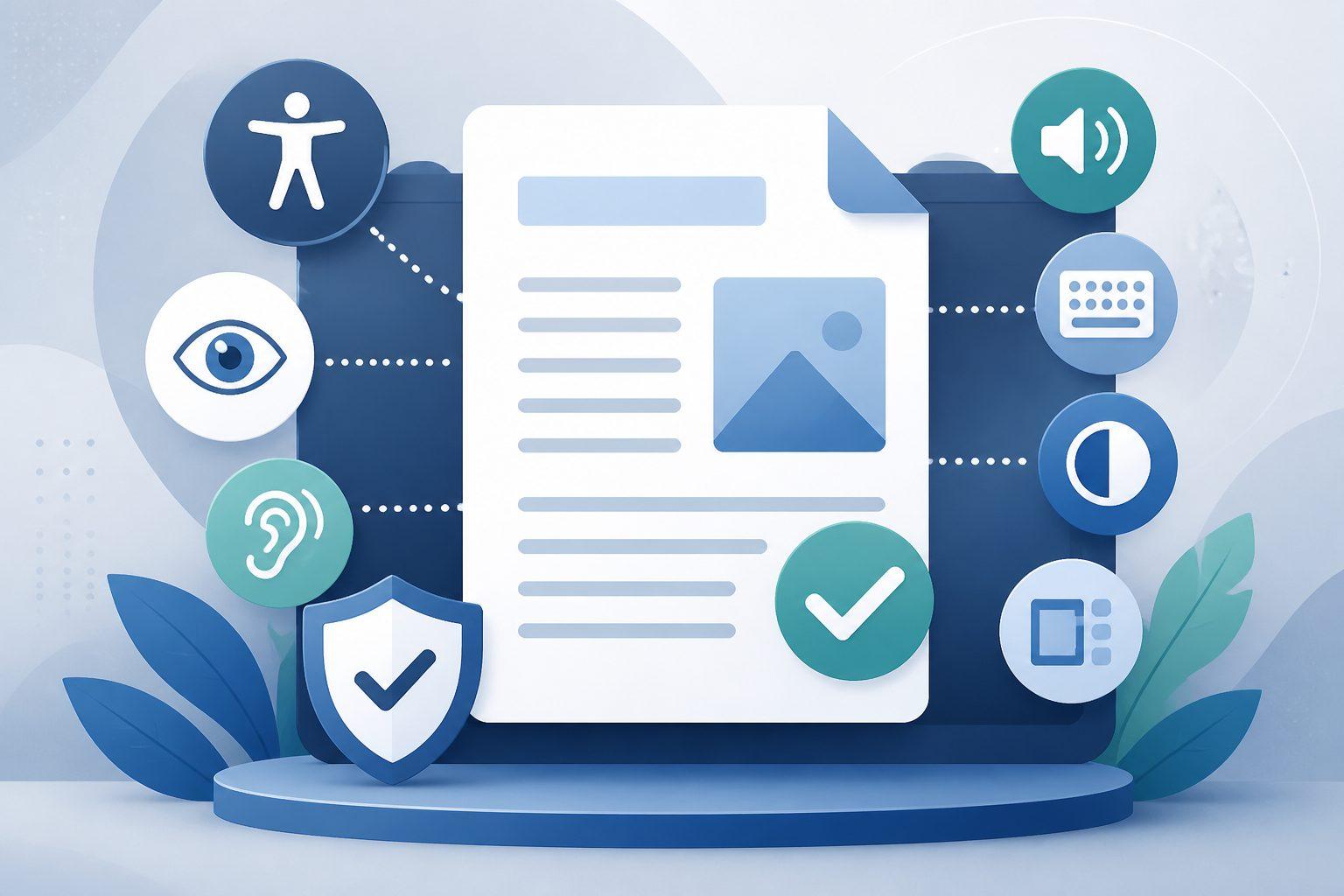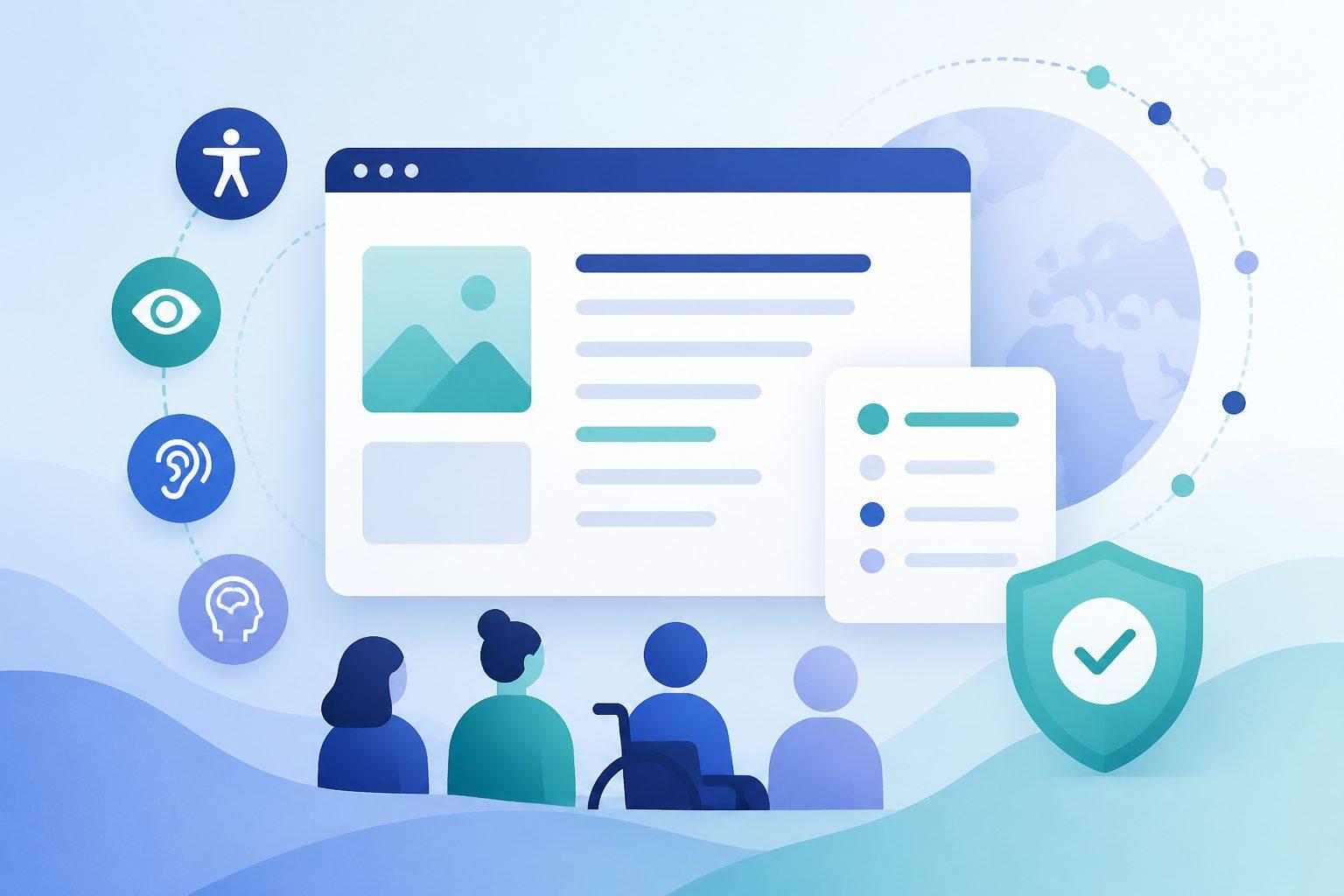
Digital accessibility is moving from “fix it at the end” to “build it in from the start.” In 2026, the most significant shifts are about how teams design, build, test, and govern accessible experiences across websites, apps, documents, and emerging interfaces.
Key takeaways
- AI can speed up accessibility work, but it still needs human review, clear ownership, and privacy guardrails.
- Laws and procurement rules are getting more specific, especially in the U.S. public sector and across the EU.
- Automation is improving, but no tool can confirm accessibility on its own, so manual and assistive technology testing still matter.
- More products are becoming multimodal, with voice, wearables, and extended reality (XR) requiring flexible input and output options.
- Cognitive accessibility is becoming more actionable, with clearer patterns for plain language, predictable UI, and reduced cognitive load.
Here are the top accessibility trends to watch in 2026
1. AI-assisted accessibility, with guardrails
Teams are using artificial intelligence (AI) to accelerate everyday accessibility tasks, especially where scale is a challenge.
Where AI is showing up:
- Captions and live transcription in operating systems and popular platforms (for example, see Apple’s Live Captions accessibility settings and Android’s Live Caption).
- Image understanding and description features that can support blind and low vision users (for example, Microsoft’s Seeing AI).
- Drafting support for content teams, such as suggesting alternative text, headings, and form labels.
What to watch in 2026: AI will likely keep improving at “first draft” accessibility outputs, but it can still miss context, introduce errors, or generate misleading descriptions. The W3C is actively exploring how machine learning and generative AI intersect with accessibility in its AI and accessibility work.
What to do now
- Treat AI output as assistance, not conformance. Keep a human in the loop for anything user-facing.
- Build a review workflow for AI-generated alternative text, captions, and summaries, especially for high-stakes content (health, legal, financial, education).
- Document how AI is used, and align it with your organization’s accessibility policy and data governance.
2. Voice and conversational interfaces become everyday UX
Voice and conversational user experience (UX) is no longer limited to smart speakers. It is increasingly built into mobile operating systems, cars, wearables, customer support, and workplace tools.
Accessibility considerations that are easy to miss:
- Not everyone can or wants to use voice. Provide equivalent keyboard and touch paths.
- Some users have speech disabilities, accents, or noisy environments. Offer text-first options and clear error recovery.
- Conversational flows still need basic UX fundamentals: predictable navigation, plain language, and visible controls.
What to do now
- Design voice features as multimodal, not voice-only.
- Test with users who rely on assistive technologies and users who cannot use voice reliably.
- If you deploy chatbots, ensure the interface supports keyboard access, focus visibility, and screen reader compatibility.
3. Accessibility Meets Virtual & Augmented Reality
Extended reality (XR) encompasses virtual reality (VR), augmented reality (AR), and mixed reality. As XR expands, accessibility expectations are becoming clearer, especially around motion sensitivity, input flexibility, and alternative output.
The W3C’s XR Accessibility User Requirements compiles user needs and practical requirements for accessible immersive experiences, including multimodal interaction and customization.
Common XR accessibility needs include:
- Comfort controls (reduce motion, adjust speed, avoid forced movement)
- Remappable inputs and multiple control options
- Captions and audio alternatives, including spatial audio considerations
- Seated and one-handed modes
- Readable UI in 3D spaces (size, distance, contrast, legibility)
What to do now
- Add accessibility requirements to XR definitions of done, not as a post-launch patch.
- Offer user controls up front (comfort settings, captions, input customization).
- Test motion sensitivity and usability with real users, not just internal demos.
4. Cognitive accessibility gets more practical
Cognitive accessibility supports people with diverse cognitive, learning, and neurodivergent profiles. The trend is not “more rules.” It is more usable patterns that help more people complete tasks with less confusion and fatigue.
The W3C’s Making Content Usable for People with Cognitive and Learning Disabilities offers concrete guidance that content and product teams can apply today.
High-impact, low-regret improvements:
- Use plain language and define uncommon terms.
- Break long processes into clear steps with progress indicators.
- Reduce distractions and avoid surprise changes in context.
- Provide helpful errors with specific fixes (not just “invalid input”).
- Avoid unnecessary time limits or offer extensions.
What to do now
- Include cognitive accessibility checks in design reviews and content QA.
- Standardize patterns for forms, navigation, errors, and help content.
- Measure success by task completion and comprehension, not only by technical checks.
5. Accessibility becomes a program metric, not a one-time project
More organizations are treating accessibility as a sustained program with reporting, ownership, and continuous improvement.
This is partly driven by procurement and governance. For example:
- In U.S. federal contexts, the Revised Section 508 standards incorporate WCAG 2.0 Level A and AA for relevant electronic content.
- In Europe, EN 301 549 is the core accessibility standard used in multiple contexts (see ETSI’s overview).
What to do now
Track metrics that can guide action, such as:
- Coverage of audits across web, mobile, documents, and third-party tools
- Trends in defect volume and time to remediate
- Training completion for designers, developers, and content authors
- Accessibility acceptance criteria in procurement and vendor management
6. Wearables & Multimodal Accessibility Interfaces
Wearables, haptics, and sensor-based interactions can enhance accessibility by providing more ways to receive and act on information.
Examples include captions and hearing support features reaching more devices, such as Apple’s announced accessibility enhancements that include Live Captions and related features.
What to do now
- Make core tasks usable on small screens and without precise gestures.
- Ensure notifications and alerts have more than one cue (visual, audio, haptic).
- Do not rely on “tap targets are tiny” as an acceptable tradeoff—design for reach and dexterity.
7. Legal requirements and standards are more precise, and deadlines are real
Accessibility requirements vary by jurisdiction and context. This is not legal advice, but in 2026, there are a few concrete developments many teams are tracking.
U.S.: ADA Title II web and mobile app accessibility rule
In 2024, the U.S. Department of Justice finalized a rule for state and local governments under Title II of the ADA. The DOJ fact sheet explains the requirements and timelines in the New Rule on the Accessibility of Web Content and Mobile Apps.
Key points to know:
- The rule sets WCAG 2.1 Level AA as the technical standard for covered web content and mobile apps.
- Compliance deadlines depend on population size. The DOJ summary lists April 24, 2026, for governments serving 50,000+ people and April 26, 2027, for smaller governments and special district governments.
EU: European Accessibility Act is in effect
The European Accessibility Act is established by Directive (EU) 2019/882, and the European Commission provides an overview on its European accessibility act page. The directive is implemented and enforced at the national level across EU member states.
WCAG updates: WCAG 2.2 is stable, WCAG 3 is still in draft
- WCAG 2.2 is a published W3C standard: Web Content Accessibility Guidelines (WCAG) 2.2. For a practical overview of what changed, see What’s New in WCAG 2.2.
- WCAG 3 is in development and not ready to use as a compliance target. The W3C notes this status in its WCAG 3 introduction.
What to do now
- Identify which laws and standards apply to your organization, based on jurisdiction, sector, and contracts.
- If you operate across regions, build a baseline (often WCAG 2.1 AA today) and track deltas to WCAG 2.2 and EN 301 549 as needed.
- Treat accessibility as ongoing operations: new content and releases can introduce new barriers.
8. Automated accessibility testing gets better, but manual testing stays essential
Automation is improving, especially when teams use standardized rules and integrate checks into continuous integration and continuous delivery (CI/CD). W3C works like the ACT Rules Format supports consistency across tools and test methods.
At the same time, W3C is clear that tools cannot do everything. Selecting Web Accessibility Evaluation Tools explains that evaluation tools cannot check all aspects automatically and that human judgment is required.
What to do now
A strong testing stack in 2026 usually includes:
- Automated checks in CI/CD for regressions and common failures
- Manual keyboard testing on key flows
- Assistive technology testing (screen readers, screen magnifiers, voice control)
- Usability feedback from people with disabilities, when possible
Final Thoughts
The most important “trend” in 2026 is not a new tool or interface. It is maturity. Organizations that treat accessibility as a shared responsibility across design, engineering, content, QA, procurement, and leadership will move faster, reduce risk, and build better experiences for everyone.